
Seven Marks of a Disciple: A Mirror for 2026
As we prepared for a new year, our pastor challenged us with a powerful question: How do you know if you’re actually becoming a fully devoted follower of Jesus Christ?
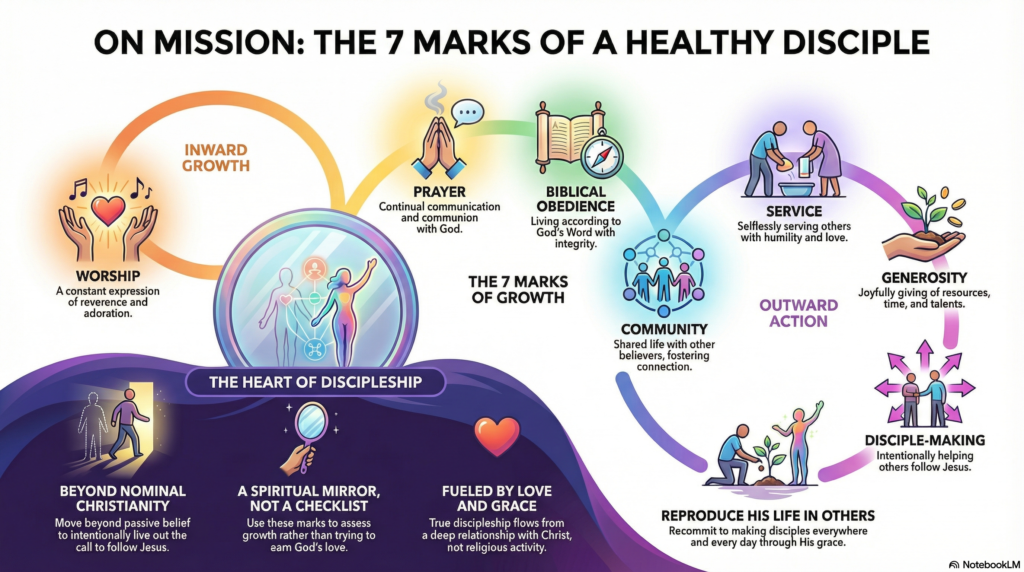
In his sermon, he walked us through seven biblical indicators—seven characteristics that mark a person in a healthy, growing relationship with Jesus. At Grace Church, we call them the Seven Marks of a Disciple, and they provide a practical framework for spiritual growth and Christian maturity. He explained how they weren’t a checklist to earn God’s love, but rather a mirror to help us respond to God’s grace.
You can watch the full sermon on the 7 marks of a disciple here, but I wanted to capture the seven questions he posed and share how they’ve shaped my own journey toward spiritual maturity. I found myself on an introspective journey throughout the sermon, and to me, those are the best kind. I hope the questions below help you reflect with clarity, conviction, and love as you step into 2026.
7 Marks of a Disciple: Questions to Gauge Your Spiritual Growth
NOTE: This segment is paraphrased from Pastor Troy’s sermon. It is not my original content. I used the transcript generated by YouTube and asked Claude.ai to help summarize.
1. Am I growing in my love for Jesus Christ?
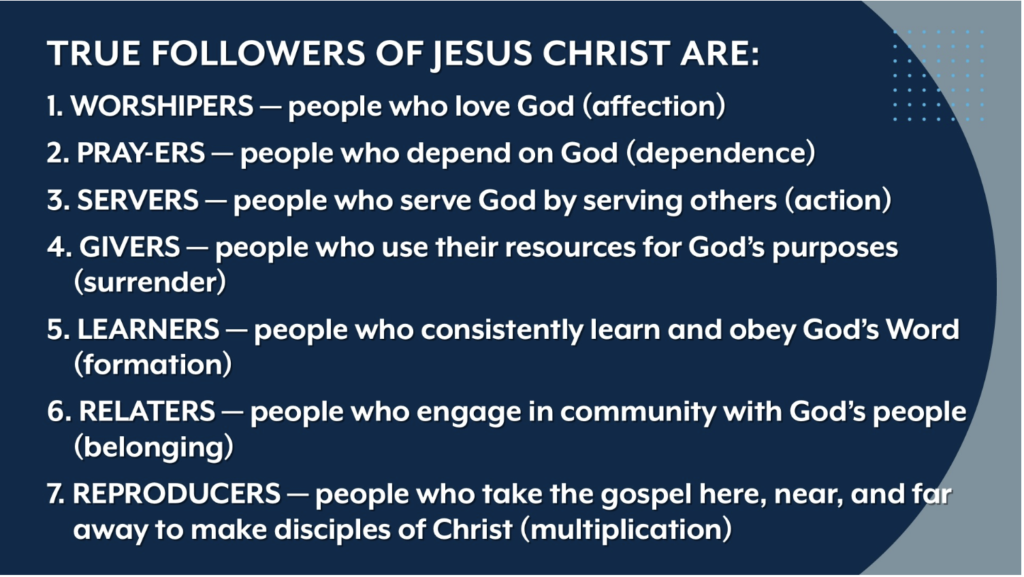
True followers of Jesus are worshipers—people who love God with their whole heart, mind, soul, and strength. The question isn’t whether you’re in a relationship with Jesus, but whether your love for Him is actually growing. Do you love Jesus more today than you did a year ago?
2. Am I actively engaged in ministry?
True followers of Jesus are servers—people who serve God by serving others. This one’s the easiest to assess because it’s measured by a simple question: Are you serving anybody? Are you meeting the needs of anyone? And remember, the first place to start is within the four walls of your own home.
3. Am I known by other people in Christian community?
True followers of Jesus are relaters—people who engage in community with God’s people. There’s no carve-out in the Bible for “ninja Christianity” where you slip in and out unnoticed. Community, not anonymity, is the goal for mature followers of Jesus Christ.
4. Am I investing financially in the cause of Christ?
True followers of Jesus are givers—people who use their resources for God’s purposes. Martin Luther said every Christian goes through three conversions. First, there is a conversion of the head. Second, there is a conversion of the heart. Finally, there is a conversion of the bank account. Usually, they don’t happen at the same time. Has the grace of Christ changed the way you think about your finances? Has God’s generosity toward you made you more generous?
5. Am I increasing in my knowledge of and obedience to the Bible?
True followers of Jesus are learners—people who consistently learn and obey God’s Word. Bible intake is the single most important spiritual discipline—it’s the one discipline that affects every other area of spiritual growth. Research shows that engaging with the Bible four times per week has dramatic effects. It impacts everything from loneliness and anger to generosity and disciple-making.
6. Am I consistently praying?
True followers of Jesus are pray-ers—people who depend on God. God speaks to us through His Word, and we speak to God through prayer. That’s the relationship. No one ever becomes a “pro” at praying. The key is seeing it less as a discipline and more as a necessity. It’s like breathing.
7. Am I making disciples of Jesus Christ?
True followers of Jesus are reproducers—people who take the gospel near and far to make disciples of Christ. Genuine discipleship is always about disciple-making. Can you point to anyone in your life that you are leading along in the Christian faith?
Growing as a Reproducer: My Discipleship Journey
I have plenty of growth that I’m excited about in all of the areas listed above but one that really stood out to me and will be an area of focus for 2026 was #7 – Reproducers
Our pastor shared this illustration that really stuck with me. He was at Ruby Tuesday with his three kids when they were 5, 3, and 1 years old. As he watched them eat dinner, he noticed something:
- His 1-year-old son couldn’t feed himself at all. His wife was cutting up food into small portions and feeding him bite by bite.
- His 3-year-old daughter could feed herself, but it was messy—spaghetti in her hair, sauce on her face. She was doing it, but it wasn’t pretty.
- His 5-year-old daughter could feed herself perfectly fine. But what struck him most was that all throughout dinner, she kept wanting to feed her little brother and sister. She didn’t just want to eat—she wanted to help feed them too.
He said that’s the picture of Christian discipleship:
When you’re born again, you’re a spiritual 1-year-old. You don’t even know how to feed yourself spiritually, so you need someone to feed you God’s Word. But the goal isn’t to stay there forever, always needing someone to slice up spiritual meat for you. The goal is to mature. You should reach the point where you can feed yourself from God’s Word, even if it’s messy at first. And ultimately, the goal is to become someone who can feed yourself AND wants to feed others.
When I heard that story, I realized: I’m doing okay with our boys. But, I still feel like the infant when it comes to sharing my faith outside our four walls. I can feed my kids spiritually, albeit quite messily. Still, I’m not yet at the place where I’m actively discipling other adults. I’m not reproducing my faith beyond my home.
And honestly? I’m okay with that. Many of us are in that infant or toddler stage in certain areas. That’s exactly why these seven marks are so helpful. They show us where we can grow.
How to Apply the 7 Marks in Daily Life
Understanding these marks of a disciple is one thing—living them out is another. Here are a few practical ways I’m working to grow as a disciple in my everyday life:
Start with one mark at a time. Rather than trying to improve in all seven areas at once, I’m focusing on being a reproducer in 2026. Pick the mark that resonates most with you and set one small, achievable goal.
Create rhythms, not rules. For our family, discipleship happens through consistent rhythms: nightly readings with our sons, Christian music in the car, and organic faith conversations with our oldest. You can find the books we love on my Christian Reading page. These aren’t rigid rules—they’re natural patterns that create space for spiritual growth.
Find accountability. Whether it’s a small group, a close friend, or your spouse, share which mark you’re working on and ask them to check in with you. Community isn’t just one of the seven marks—it’s the container that helps all the others grow.
Revisit the questions regularly. I plan to come back to these seven questions quarterly throughout 2026. Spiritual maturity isn’t linear, and different seasons of life will reveal different areas where we need God’s grace.
The beautiful thing about these marks is that they’re not about perfection—they’re about progress. They’re not about earning God’s love—they’re about responding to the grace He’s already given us.
Using the 7 Marks as a Mirror for Spiritual Growth
As our pastor reminded us, these seven marks aren’t a checklist to earn God’s love. They’re a mirror to help us see where we’re growing—and where we need God’s grace to transform us.
As you head into 2026, I’d encourage you to watch the full sermon on the 7 marks of a disciple and ask yourself: Which of these seven marks do I need to grow in this year? Whether you’re focusing on prayer, service, Bible reading, community, giving, worship, or making disciples, remember that spiritual growth is a journey, not a destination.
For me, it’s reproducing my faith — starting at home. What about you? Drop a comment below and let me know which mark resonated most with you—I’d love to encourage you on your journey.